
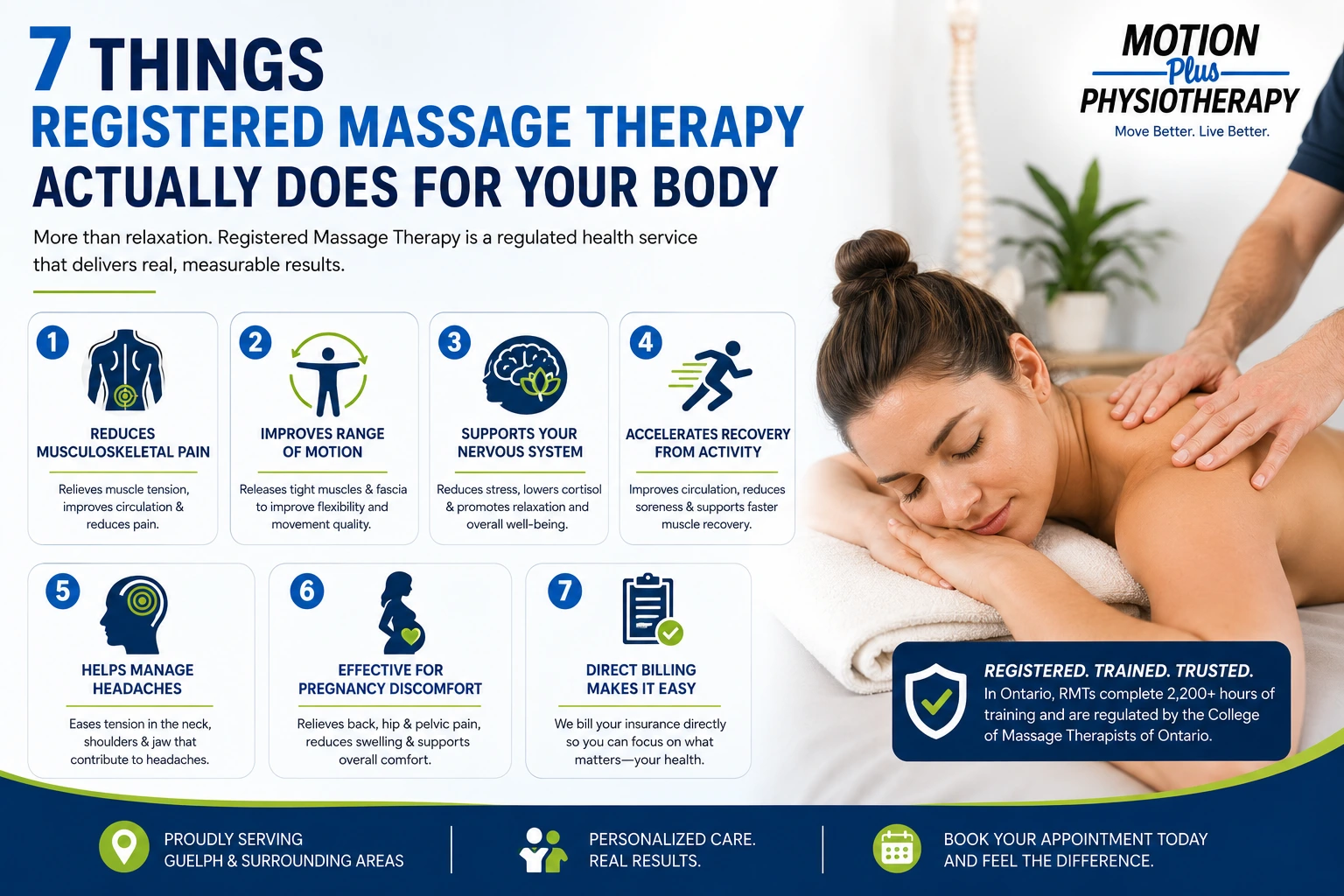
7 Things Registered Massage Therapy Actually Does for Your Body
People book their first massage therapy appointment for all kinds of reasons. Neck pain from working at a desk. A referral from their physiotherapist. The hope of finally sleeping through the night without waking up stiff. Stress that has settled somewhere between their shoulder blades and refuses to leave. What surprises many people is how much more registered massage therapy offers beyond simple relaxation. I want to talk about that, because in my experience, the people who get the most out of massage therapy are the ones who understand what is actually happening and why it works.
This is particularly relevant physiotherapy in a place like Guelph, Ontario, where a large portion of the population is physically active, many people work in demanding occupations, and the combination of a university community and established local businesses means a real range of bodies with a real range of needs walking through clinic doors every week.
1. It Directly Reduces Musculoskeletal Pain
Registered massage therapy is a regulated health profession in Ontario. The therapists who practice it are trained to assess and treat the soft tissues of the body, including muscles, tendons, ligaments, fascia, and the connective tissue that holds all of it together.
One of the most direct clinical effects of massage therapy is pain reduction. This works through several mechanisms. Mechanical pressure on tight or restricted tissue improves blood flow, reduces localized ischemia, and helps normalize the resting tone of overactive muscles. Stimulation of mechanoreceptors in the skin and underlying tissue has a modulating effect on pain signals traveling through the nervous system. And the reduction in muscle tension physically decreases the load on joints and other structures that are often secondary pain sources.
For people dealing with neck pain, upper back tension, low back pain, rotator cuff tightness, ITB syndrome, calf tightness from running, or hip flexor restriction from prolonged sitting, massage therapy delivers measurable, lasting improvement when it is applied consistently and with proper clinical reasoning behind it.
What to expect: A registered massage therapist begins with a health history and a brief assessment before any hands-on work begins. The treatment itself is adjusted to your specific tissue presentation and your comfort level throughout.
2. It Improves Range of Motion and Movement Quality
Tight muscles and restricted fascia limit how freely your joints can move. This is something most people notice gradually. You stop being able to turn your head all the way to check your blind spot. Your shoulder does not lift overhead the way it used to. Your hip feels stiff for the first twenty minutes of a morning walk before it starts to loosen up.
Massage therapy works directly on these restrictions. Through sustained pressure, myofascial release techniques, and specific work along the length of muscle fibers, a registered massage therapist can meaningfully reduce the tissue tension that limits your range of motion.
This is especially valuable when combined with physiotherapy. A physiotherapist might be working on joint mobility and motor control, but if the surrounding soft tissues are chronically restricted, the joint work has a ceiling. Getting the muscles and fascia moving freely first creates the conditions for the rest of the rehabilitation work to be more effective.
Best for: Anyone dealing with restricted shoulder, neck, hip, or thoracic mobility, athletes looking to maintain tissue health during heavy training periods, or people recovering from injury alongside physiotherapy.
3. It Supports the Nervous System, Not Just the Muscles
A lot of what shows up in the body as muscle tension is not actually a muscle problem. It is a nervous system problem. The muscles are simply the output of a nervous system that is under sustained stress or that has learned to hold a particular pattern over time.
This is why people with high chronic stress often carry their tension in the same places repeatedly, the jaw, the upper traps, the low back, regardless of how much stretching they do. The stretching addresses the tissue. But the nervous system is still sending the same signals.
Registered massage therapy, particularly techniques focused on the parasympathetic response, directly down-regulates the stress response. Heart rate variability improves. Cortisol levels have been shown to decrease following massage. The nervous system shifts away from a heightened alert state. The result is not just that your muscles feel looser. It is that the system driving the tension starts to relax.
For people in Guelph managing demanding work schedules, academic pressure, parenting, or the physical stress of physically active lives, this aspect of massage therapy has real consequences for sleep quality, pain sensitivity, mood, and overall resilience.
4. It Accelerates Recovery From Exercise and Physical Activity
Guelph is a city where people take their physical activity seriously. The running trails along the Speed River, the cycling culture, the recreational sports leagues, the gym communities, and the increasing number of people doing endurance events all contribute to a population that asks a great deal of its body on a regular basis.
Exercise creates metabolic byproducts, micro-tears in muscle fibers, and localized inflammation as part of the normal adaptation process. Recovery from that stress is where the actual improvement happens. Massage therapy accelerates this process by improving circulation in the affected tissues, supporting lymphatic drainage, and reducing the duration and intensity of delayed onset muscle soreness.
Athletes who incorporate regular massage therapy into their training and recovery protocols tend to train more consistently, deal with fewer overuse injuries, and maintain better tissue quality over the long term. This is not anecdote. The evidence for massage as a recovery tool is well-established and continues to grow.
Best for: Runners, cyclists, hockey players, gym-goers, and anyone engaged in regular moderate to high intensity physical activity who wants to maintain tissue health and reduce injury risk.
5. It Helps Manage Headaches, Including Tension and Cervicogenic Types
Headaches are one of the most common reasons people in Guelph seek massage therapy, and they are also one of the areas where the results are most consistently satisfying from a clinical standpoint.
Tension-type headaches often originate in the suboccipital muscles at the base of the skull, the upper trapezius, the levator scapulae, and the muscles of the jaw. Sustained desk postures, prolonged screen use, stress, and disrupted sleep all contribute to the chronic tightness in these areas that eventually refers pain into the head.
Cervicogenic headaches, which originate from the cervical spine and surrounding structures, are another category where manual soft tissue work and massage therapy can produce significant and lasting improvement.
A registered massage therapist can assess and treat the specific muscles and soft tissue structures contributing to your headache pattern. Many people who have been managing frequent headaches with medication find that consistent massage therapy reduces both the frequency and the intensity of their headaches meaningfully over time.
What to expect: Work focused on the upper cervical region, posterior neck, occiput, jaw muscles, and upper back, along with guidance on postural habits and home care that will support the clinical work between appointments.
6. It Is Highly Effective for Pregnancy-Related Discomfort
Pregnancy changes the body quickly and substantially. The growing belly shifts the center of gravity and places new demands on the low back, hips, and pelvis. Ligament laxity increases throughout pregnancy in response to hormonal changes, which affects joint stability. Sleep positions are restricted. The demands on the upper back and neck from changing posture are significant.
Registered massage therapists who are trained in prenatal massage understand how to position and support a pregnant body safely and comfortably, and how to address the specific tissue presentations that are common during pregnancy. Low back pain, SI joint pain, hip tightness, thoracic tension from a growing belly pulling the spine into new curves, and swelling in the lower legs are all conditions that respond well to appropriate massage therapy.
Prenatal massage in the second and third trimester is safe when performed by a registered therapist with appropriate training and when any contraindications are properly screened. If you are pregnant and dealing with musculoskeletal discomfort that is affecting your daily life, it is worth asking your healthcare team whether massage therapy might help.
7. Direct Billing Makes It Accessible Without the Paperwork Burden
One of the practical barriers to consistent massage therapy for many people is the hassle of managing insurance claims. You pay out of pocket, hold onto your receipts, submit your claim, and wait for reimbursement. For people who need regular treatment, this process adds friction that often results in delayed or skipped appointments.
Many registered massage therapy clinics in Ontario, including practices in Guelph, offer direct billing to major insurance providers. This means the clinic submits the claim directly on your behalf and you pay only your portion at the time of the appointment. The administrative burden is significantly reduced, and accessing the care you need becomes much simpler.
If you have extended health benefits that include massage therapy, which is the case for a large portion of people employed in Guelph, checking whether your clinic offers direct billing is a reasonable first question before booking. It removes one of the most common reasons people delay or reduce the frequency of treatment that is actually helping them.
Registered massage therapy is not a luxury. It is a regulated, evidence-supported health service that has direct, measurable effects on pain, mobility, recovery, nervous system function, and quality of life. Whether you are dealing with a specific musculoskeletal complaint, managing the demands of an active life in Guelph, or working through a pregnancy or a period of high stress, the right massage therapist, working as part of a coordinated care approach, can make a real and lasting difference.
The keyword in all of this is registered. In Ontario, registered massage therapists have completed a minimum of 2,200 hours of clinical and academic training and are regulated by the College of Massage Therapists of Ontario. When you book with a registered massage therapist, you are accessing a trained professional operating within a defined scope of practice, not simply someone who learned a relaxation technique.
That distinction matters. And in Guelph, you have access to it.