
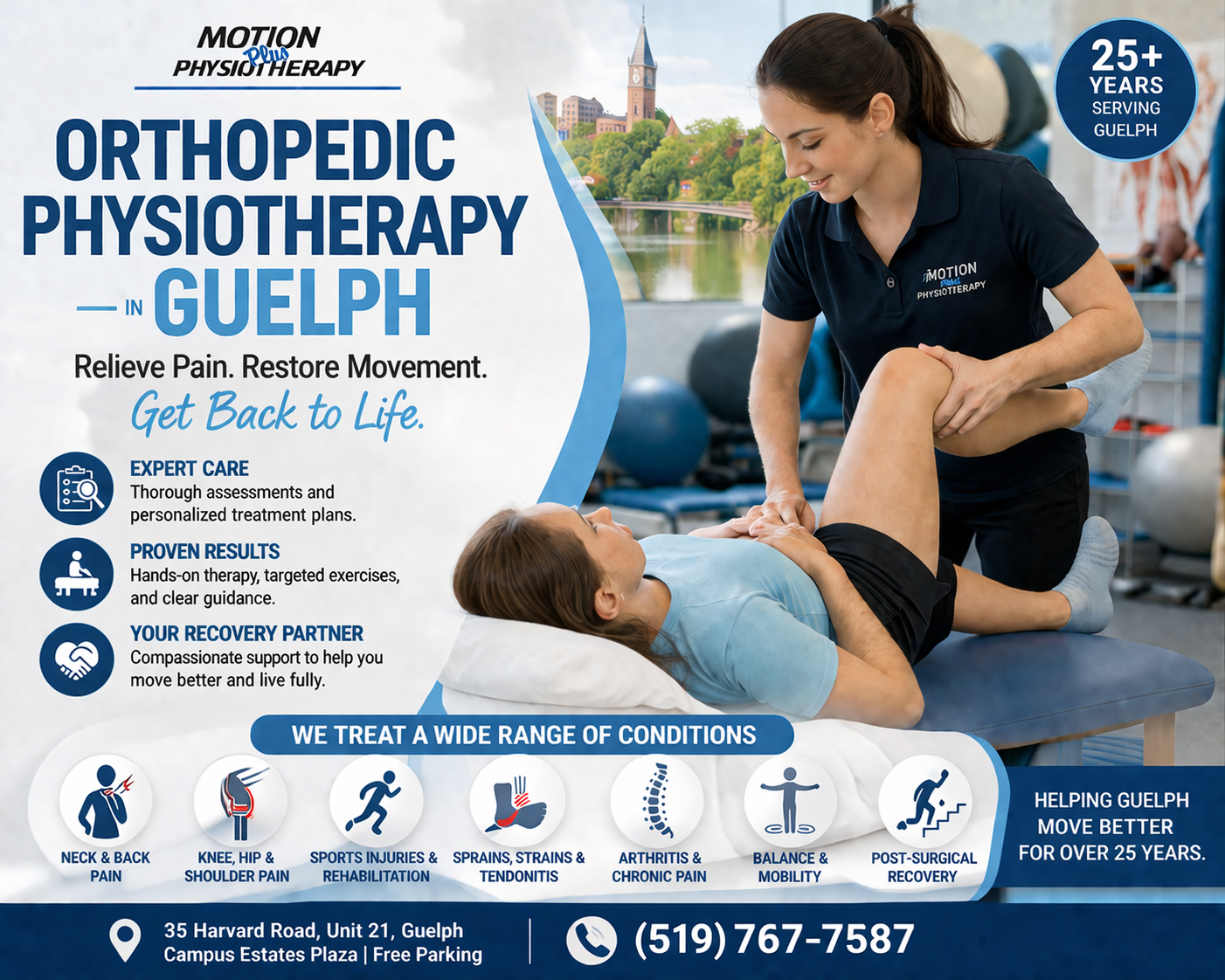
Orthopedic Physiotherapy in Guelph: What It Is, Who It Helps, and What to Expect
Your knee has been grumbling at you for three months. You have tried rest, a compression sleeve, and enough ibuprofen to stock a small pharmacy. It feels a little better some mornings and then, the moment you take the stairs two at a time or go for that Sunday walk around Riverside Park, it reminds you exactly who is in charge.
Sound familiar?
If you have been searching for orthopedic physiotherapy in Guelph, you are probably not looking for a lecture on anatomy. You are looking for someone to explain what is actually going on, whether it can be fixed, and how long it is going to take.
Let me try to do exactly that.
What Is Orthopedic Physiotherapy, Really?
Orthopedic physiotherapy is the branch of physiotherapy focused on your musculoskeletal system. That means everything involving your muscles, bones, joints, ligaments, tendons, and the connective tissue that holds it all together.
If it moves and it hurts, there is a good chance orthopedic physiotherapy has something to say about it.
It covers a wide range of conditions. Some people come in with a fresh acute injury, a sprained ankle from a trail run at Preservation Park or a shoulder strain from lifting something awkward. Others come in with pain that has been slowly building for years. Joint replacements, post-surgical rehabilitation, repetitive strain injuries from work, arthritis, bursitis, tendonitis, and fracture recovery all fall squarely within this area of care.
What makes it different from just “going to physio” in a general sense is the depth of the musculoskeletal focus. An orthopedic physiotherapist is specifically trained to assess movement patterns, identify which structures are involved, understand how the different components of the musculoskeletal system are influencing each other, and build a treatment plan that addresses the root cause rather than just the site of pain.
The Part Most People Get Wrong About Musculoskeletal Pain
Here is something I tell patients all the time: where you feel the pain is not always where the problem is coming from.
A patient came in last fall with what she described as a stubborn hip problem. She had self-diagnosed IT band syndrome after reading about it online. And yes, her IT band was tight and irritated. But the reason it kept flaring up no matter how much she stretched it was that her gluteal muscles were not doing their job properly. Her hip flexors were carrying a load they were never meant to carry alone, and the IT band was paying the price every time she went for a run along the Speed River trail.
We treated the hip, not just the band. She ran her next 10K without stopping.
This is exactly what a thorough orthopedic physiotherapy assessment is designed to uncover. Not just the tissue that is complaining loudest, but the movement dysfunctions and compensatory patterns that set the whole thing in motion.
Who Benefits From Orthopedic Physiotherapy in Guelph?
Honestly? A lot more people than typically show up.
Here are some of the most common scenarios I see at the clinic.
The person who waited too long. They had an injury six months ago, pushed through it, and now something that should have been a two-week recovery has become a chronic problem with a life of its own. This is probably the most common story I hear.
The post-surgical patient. Knee replacement, rotator cuff repair, ACL reconstruction, hip replacement. Surgery creates the conditions for recovery. Rehabilitation is what actually produces it. The two are not the same thing, and the physiotherapy phase is where function is genuinely rebuilt.
The worker with repetitive strain. Guelph has a strong trades and manufacturing sector, and a lot of people whose daily work involves repetitive motion patterns that eventually produce shoulder, elbow, wrist, or neck problems. These respond very well to orthopedic physiotherapy when they are treated properly rather than just managed with pain relief.
The active person hitting a wall. Recreational runners, cyclists, hockey players, golfers, gardeners. People who love being active and are frustrated that something is stopping them. Sports injury rehabilitation is a big part of what orthopedic physiotherapy addresses.
The person managing a chronic condition. Osteoarthritis, osteoporosis, fibromyalgia, and chronic low back pain are long-term conditions that cannot be cured but can be managed very effectively with the right physiotherapy approach. Function can be preserved, pain can be reduced, and quality of life can be meaningfully improved.
The older adult who wants to stay independent. This one matters to me a lot. Balance, strength, joint stability, and confidence in movement all decline without intervention as we age. Orthopedic physiotherapy can address each of these directly and specifically.
What Does Orthopedic Physiotherapy Treatment Actually Involve?
This is where the real question lies for most people who have never been through the process before, or who have had experiences that did not feel particularly individualized.
The Assessment Comes First
Before anything else happens, your physiotherapist needs to understand your full picture. That means a detailed health history, understanding your goals, and a hands-on movement assessment.
I want to know when it started, what makes it worse, what makes it better, what you have already tried, and what you are hoping to get back to. The last question is one people are sometimes surprised by. But it matters. Getting back to gardening looks different from getting back to competitive hockey, and your treatment plan should reflect your actual life.
The physical assessment looks at how you move, where your range of motion is limited, how your muscles are loading and firing, and how your joints are behaving under different demands. It is detailed work, and it takes time when it is done properly.
Manual Therapy
Hands-on treatment is a core component of orthopedic physiotherapy. This can include joint mobilization and manipulation to restore movement at restricted joints, soft tissue techniques to address muscle and fascial tension, and specific manual approaches for different conditions.
Manual therapy is not the whole treatment. It is a tool that creates conditions for the other work to be more effective.
Exercise Therapy and Rehabilitation
This is where most of the actual recovery happens. A progressive, individualized exercise program targets the specific deficits your assessment identified. Strength, stability, range of motion, proprioception, and load tolerance are all built systematically over the course of your rehabilitation.
The exercises you receive should make sense for where you are right now and where you need to get to. If they feel completely random or you do not understand why you are doing them, that is worth asking about.
Education and Self-Management
Understanding your condition changes how you experience it and how effectively you rehabilitate. Part of good orthopedic physiotherapy is helping you make sense of what is happening in your body, what to expect, and what you can do between appointments to support your own recovery.
This is not optional. Patients who understand their condition recover better. The research on this is consistent.
Conditions We Treat at Motion Plus Physiotherapy
At Motion Plus Physiotherapy, our team of manual therapists works with a broad range of orthopedic and sports-related conditions, including:
- Neck pain and cervicogenic headache
- Back pain, including lumbar and thoracic conditions
- Shoulder injuries and rotator cuff problems
- Knee pain, including osteoarthritis and post-surgical rehabilitation
- Hip pain and hip replacement recovery
- Ankle and foot conditions
- Elbow, wrist, and hand injuries
- Tendonitis and bursitis
- Sprains and strains
- Arthritis and osteoporosis
- Repetitive strain injuries
- Fracture rehabilitation
- Fibromyalgia
- Benign Paroxysmal Positional Vertigo (BPPV)
- General deconditioning
If what you are dealing with is not on that list, it does not mean we cannot help. It means it is worth a conversation.
Why Motion Plus Physiotherapy for Orthopedic Care in Guelph?
We have been serving Guelph since 1997. That is over 25 years of treating real people with real musculoskeletal problems in this community.
A few things I think genuinely set the experience here apart.
Assessment before everything. No treatment starts before a thorough evaluation. We want to understand your problem before we start working on it. This sounds obvious, but it is not universal.
Individualized treatment plans. You are not receiving a generic program because you have a generic diagnosis. Your plan is built around your assessment findings, your goals, and your life.
Evidence-based practice. Our team is committed to ongoing professional development and to using approaches that are supported by current research. The field of orthopedic physiotherapy moves forward, and so do we.
Collaborative care. We work with your physician and the rest of your healthcare team. If we find something that needs a different kind of attention, we say so directly. Your recovery is the goal, not just your next appointment with us.
A clinic that is actually accessible. Ground-level space, free parking right out front, and direct billing to most major insurers. We try to remove every barrier between you and getting the care you need.
Frequently Asked Questions About Orthopedic Physiotherapy
Do I need a referral to see an orthopedic physiotherapist in Guelph?
No. In Ontario, physiotherapists are primary care providers. You can book directly without a physician referral. If your insurer requires a referral for reimbursement purposes, that is a separate matter worth checking with your plan, but clinically you do not need one to access care.
How many sessions will I need?
It depends on what you are dealing with, how long it has been going on, and how your body responds. A fresh acute injury might resolve in a handful of sessions. A chronic condition or post-surgical rehabilitation typically takes longer. Your physiotherapist will give you a realistic picture after your assessment and will update that estimate as your treatment progresses.
Will it hurt?
Some treatments involve working on sensitive tissues, and that can feel uncomfortable in the moment. A good physiotherapist works within your tolerance and communicates clearly about what to expect. The goal is never unnecessary discomfort. But some degree of therapeutic challenge is part of how tissue heals and strength returns.
Is orthopedic physiotherapy covered by insurance?
Most extended health benefit plans in Ontario include physiotherapy coverage. Direct billing is available at our clinic for many major insurers, which means we handle the claim on your behalf and you pay only your portion at the time of your appointment.
What should I wear?
Comfortable clothes that allow your physiotherapist to assess the area that is bothering you. For a knee or hip problem, shorts are ideal. For a shoulder, something easy to remove or that allows access to your upper back and shoulder. You do not need any special gear.
Taking the Next Step
Pain has a way of quietly adjusting how you live. You stop taking the stairs. You skip the morning walk. You modify how you sleep, how you sit, how you move, just to avoid the thing that hurts. After a while, those adjustments feel normal.
They do not have to be permanent.
Orthopedic physiotherapy in Guelph is not about pushing through pain or being told your problem is all in your head. It is about having someone take a careful look at what is actually happening in your body, explain it to you clearly, and work with you on a plan to get you back to the life you want.
If you have been managing something and wondering whether it is worth coming in, the answer is almost always yes. The longer a musculoskeletal problem goes unaddressed, the more the body builds compensatory patterns around it, and the more complex the rehabilitation becomes.
We are located at 35 Harvard Road, Unit 21 in Guelph, right in the Campus Estates Plaza, with free parking and easy ground-level access.Book your assessment today and let us figure out together what your body needs to move well again.